Pages of dwindling brown imposed with black and white imagery revolve on a screen in the Harry Ransom Center: ink lungs blossoming with air, arms outstretched in perennial movement and other anatomical sketches, all featured in Lisa Olstein’s newest poetry book titled “Distinguished Office of Echoes.” Olstein reads from the work, her voice reverberating through the dark room. She allows silence to prevail in intervals as singular strands of punctuation drip down pages of unmarred white.
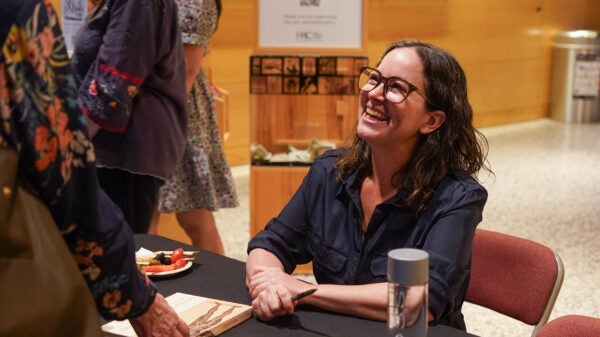
Olstein, a Guggenheim Fellowship recipient and Pushcart Prize winner, serves as the Ellen Clayton Garwood Centennial Professor of Creative Writing. The prolific writer teaches at the New Writers Project, Michener Center, and the undergraduate English program. The reading and celebration on Oct. 2 came after her anthology debuted in stores in September.
Her penchant for combing through shelves of old books led to a 16-year journey of collecting and working with the texts that would one day serve as the source material of her sixth poetry collection. Olstein used three antique reference books to craft her book of longform poems. The three poems are born from the texts, which feature 19th and early 20th century studies of human anatomy, sea life, and war and peace spilling across pastel-hued maps.
“In their moment, they were cutting-edge examples of knowledge,” Olstein says. “But now I’m gazing at them from across, you know, more than 100 years, and I can see the way in which there are relics of a different time and place: the printing paper, the technology, the kinds of ink, and then, of course, the knowledge itself is so very outdated and so sometimes very quaint and beautiful, other times sort of horrifying to discover, you know, what we thought made for a certain disease or that kind of thing. So (it’s) a really interesting kind of layered response to these beautiful old source texts.”
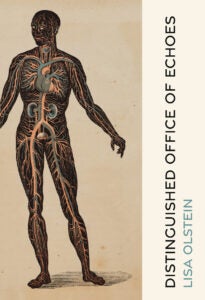
It was the midst of the pandemic when Olstein began to fully focus her poetic efforts on the books, dedicating nine months to this endeavor during her Guggenheim Fellowship. She immersed herself in a tactile and palpable experience, stripping the books nearly to the bones with great concentration and intentionality. Using white watercolor, cutouts, collage and a process of layering pages allowed Olstein to pluck words she wanted to use from the source text and arrange them with care, considering the cadence of the original texts. Technical illustrations such as the draping silhouettes of jellyfish and diagrams of bone systems attain a poetic sensibility through Olstein’s reconfiguration of word and imagery.
“I think of it as the process of dowsing, where you use a wooden wand and it pulls in the direction, supposedly, of underground water. I would, sort of obsessively, and in this almost devotional way, spend a huge amount of time with the texts and see what drew my attention, what words seemed to kind of almost glimmer or suggest connections between themselves, between the images,” Olstein says. “So, it was a very embodied and very kind of material process of discovery. Then different themes or threads or throughlines seemed to kind of emerge, and then I could kind of follow the trail of breadcrumbs as it made itself visible to me.”
Olstein refers to the original texts as “portraits of the pursuit of knowledge” that, while flawed, spark curiosity and inquiry. Notably, the physicality of this project was far different from her prior poetic work, and she enjoyed navigating and experimenting with this “externalization.”
“Instead of having these very specific, hierarchical, paternalistic, prototypical medical textbooks speaking with the voice of the expert on all of these subjects in a way that you might anticipate in 1876, what I wanted to do was get inside and recapitulate that very material, to inhabit a different gaze, to kind of uncover different histories from within the very body of the text,” Olstein says.
Through the creative process, Olstein reflected on a catastrophic climate disaster that affected a place she once called home, the passing of a dear friend, and the thralls of illness she herself experienced while working on the project. Playing with space, punctuation and the lack thereof, Olstein’s molding and alteration of the source texts consider the “presence of absence.”
“I think that, in the end, each (poem) did become an exploration of something quite personal and often with a really difficult kernel at the center or the heart of it, but something that I needed to approach from a felt vantage point of some distance or some perspective outside of myself,” Olstein says. “That process of discovery is often a process of realizing this is how I feel, or this is the thing that I’m still trying to understand, or the loss that I’m still grieving, and we don’t know it exactly in that way at the outset. We discover it through our work, and that was very much the case here.”