The summer after his freshman year at Harvard University, Kyle Mahowald spent his days poring over black and white boxes. As an intern for Will Shortz, the crossword editor of The New York Times since 1993, Mahowald sifted through mail-in submissions, wrote acceptance and rejection letters, and edited puzzles until they were in pristine shape each week for their eager solvers. It was a natural next step for Mahowald, who discovered his passion for puzzles thanks to a high school librarian who printed out copies of the crossword.
“That’s how I kind of got hooked,” he says. “Then I started playing around with making crosswords and made a few for my school paper. It was really fun to see people in the hallway trying to solve the crosswords, and then I got more and more into it.”
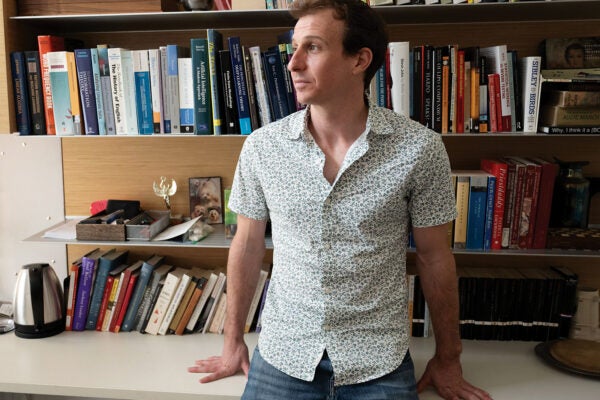
Now an assistant professor of linguistics at The University of Texas at Austin, Mahowald spends most of his time researching and leading courses on computational linguistics, where he examines the relationship between human language and language technologies like today’s AI language models. Still, he has far from abandoned his teenage hobby. Since 2004, Mahowald has published 18 of his own puzzles in The New York Times and solved countless more, finding an intersection between the craft and his academic discipline.
“There’s something very structural and mathy about designing (and filling) a crossword grid and solving a puzzle in the same way there’s something scientific about linguistics,” he says. “At the same time, the underlying phenomenon is linguistic. If you really enjoy language and wordplay and thinking about words, (crosswords) can be a really fun way to get to do that while also exercising multiple parts of your mind.”
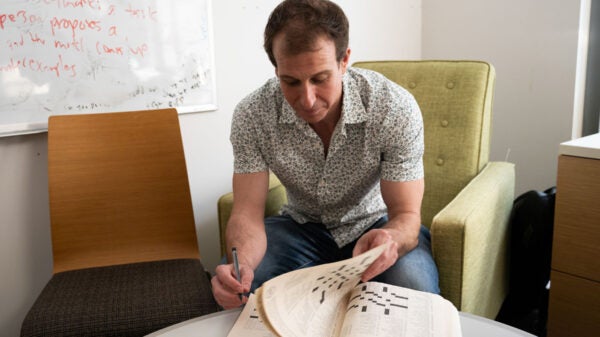
While many can say they have solved a crossword puzzle, fewer can say they have made one. So how is it done? Mahowald begins by fashioning the grid, which is typically done with the help of computer software. This involves thinking “defensively” about the relationship between each answer word and black square, he says.
“You want the grid to be full of fun, lively answers and generally free of obscurity,” he says. “You don’t want it to be the case that if the puzzle is a hard puzzle, it’s hard because the person just doesn’t know the words, right? That’s kind of unsatisfying.”
Rather than unfamiliar words, a puzzle’s difficulty should come from the clues, which are written after the grid is complete and often changed by a puzzle’s editor, Mahowald says. By strategically crafting his grid, Mahowald can better avoid “crosswordese,” or words that appear frequently in crossword puzzles but infrequently in everyday conversation. Rather, he strives to introduce fresh yet familiar phrases within his puzzles.
“If someone is the first to use some new phrase that has come around and is now very familiar, that can be a kind of thrill as a constructor,” he says.
While he has not constructed a puzzle professionally in a few years, solving is a different story. In fact, Mahowald and his partner Robbie Kubala, an assistant professor of philosophy at UT, often travel to Stamford, Connecticut, to compete in the American Crossword Puzzle Tournament. Though Mahowald reintroduced him to the hobby, speed-solving comes more naturally to Kubala, who placed in the top 25 solvers at his last tournament.
“(Crosswords were) never a serious hobby until Kyle and I started dating,” Kubala says. “At that time, he was still writing crosswords, and he sort of got me interested in solving them. … Over the years, as I did more and more and more, I got a lot more practice under my belt. I at some point passed him as far as speed-solving goes.”
Beyond the tournament, Mahowald typically prefers a calmer solving experience.
“I think creating (crosswords) exercises some creative, artistic kind of impulse, whereas solving them is more relaxing, unwinding,” he says. “So, I feel like they have kind of different niches for me.”
Which is the satisfying thing about crosswords, right? They’re designed to be solvable and have an answer. Not all problems in life are that way, but the crossword is that way.
As an academic, Mahowald has also explored crossword puzzles through a linguistic lens. In 2023, he contributed to an article published in The Atlantic that explores the relationship between crosswords and compositionality, or the idea that meaning in language is derived from individual parts that fit together in a specific way. Multiword phrases whose meaning is obvious in everyday speech must have significance beyond their compositional meaning in order to be “good answers” in crosswords, he says.
“We have intuitions about language for things that we have only limited experience with,” he says. “I think the crossword can be a way to play with that and explore those kinds of phenomena by thinking a lot about what will be familiar, and what will make people smile when they see a particular entry.”
Whether he is constructing or solving, ultimately, Mahowald looks forward to the reliable fulfillment of a guaranteed solution.
“I think what drives a lot of puzzle solvers is the moment of feeling like you’re stuck and then realizing, ‘Oh, aha! There is a nice solution,’” he says. “Which is the satisfying thing about crosswords, right? They’re designed to be solvable and have an answer. Not all problems in life are that way, but the crossword is that way.”