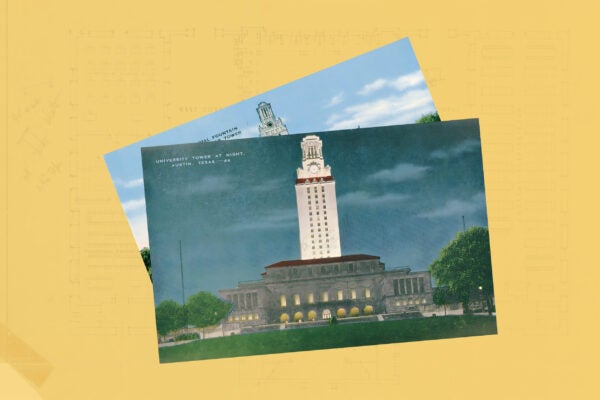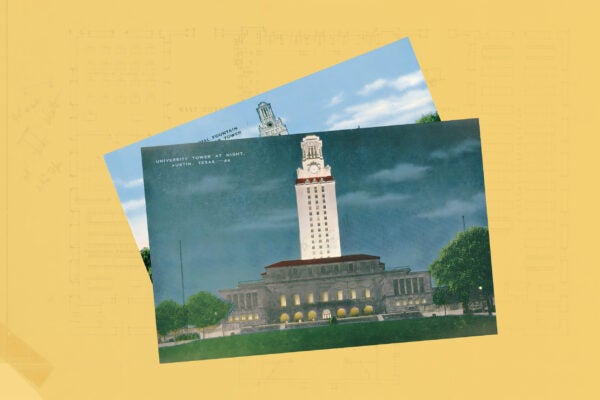
Usually, as the last light of day melts into the evening, the familiar ivory glow of the Tower illuminates The University of Texas campus. But some nights, the iconic landmark gleams with a vibrant orange hue that can only mean one thing — there’s something to celebrate.
Orange on top on a fall Saturday night? Texas Football has earned a victory on the field. Orange all over on the Sunday before the academic year begins in August? Picture thousands of lively first-year students scattered across Main Mall as the landmark lights up with their class year for the first time. From athletic accomplishments to academic achievements and University milestones, the Tower offers its warm glow to commemorate dozens of events each year. But the magic can’t happen without the team that ensures every detail is in place before the sun goes down.
When Augie Carrasco gets word from the University leadership team that it’s time to light the Tower, he springs into action. As a senior electrician for the University’s electrical shop, Carrasco’s team is responsible for maintaining the Tower’s 244 light fixtures — 108 white and 136 orange — which are located throughout four levels: the 10th level of the shaft, the observation deck, above the clocks, and at the crown of the building. These fixtures are serviced at regular periods to ensure they are working and ready for lightings, he says. While the actual lighting is done remotely through a programmable computerized system, which replaced an analog system in 2016, it’s Carrasco’s job to come to campus and verify that the Tower has properly
donned its orange hue.
“I’m on call 24/7, no matter what,” says Carrasco, who has been lighting the Tower for 23 years. “I’m on standby every day, just in case we need to do something to the Tower.”
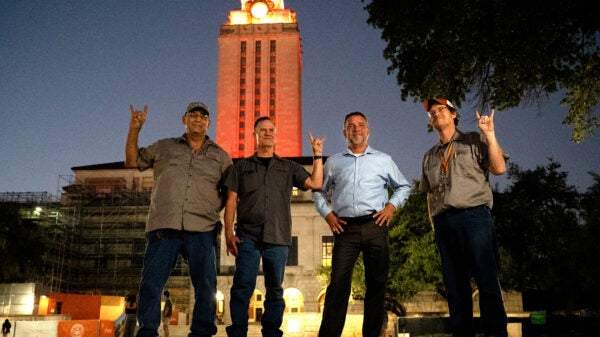
The 307-foot Tower has served as a radiant symbol of Longhorn success since 1937. Carl J. Eckhardt, an engineering professor who led the University’s physical plant for 40 years, is credited with creating the tradition of lighting the Tower orange and oversaw the original installation of the building’s exterior light fixtures. In 1947, he worked alongside a seven-member committee to create UT’s first Tower lighting guidelines, which are still used today.
Some occasions call for extra adornment, like Commencement and national championship wins, when the windows of the Tower join the display. This tradition began in 1962, when the Tower windows spelled out “UT” to celebrate Longhorn football’s first no-loss record in over 40 years. On New Year’s Day 1964, the Tower displayed a “1” for the first time to mark the team’s first national championship. Today, it takes approximately six people in a joint effort between the electrical and carpentry shops to pull off a window display, Carrasco says. Luckily, they have it down to a science, carpentry shop supervisor Conan Dillard says.
“We’ll get a lighting plan, which will show us which windows need to (be) lit and which ones go dark for the numbers or anything we need to put on the Tower,” he says. “Then we just go floor to floor, open and close windows as we need and make sure everything’s lit up.”
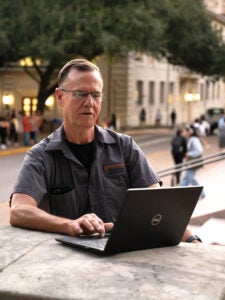
On the Tower’s south side, which faces the Texas Capitol, additional light fixtures sit beneath the windows to brighten the display. Once the windows are arranged and the Tower is lit, Carrasco takes photos to send to his supervisor, who shares them with the leadership team to confirm that the job is done. Though the department receives advance notice for most events that require a window display, some celebrations can happen on a whim. That’s when the staff steps up to pull it off, Dillard says.
“We just have to make it happen,” he says. “Even if it’s a ‘Hey, we’ve got to do this in an hour,’ we just make it happen. So big kudos to the guys who all have to come in here, drop everything they’re doing just to show up and make sure everything runs smooth.”
While most floors of the Tower sit vacant or are used for storage, recent restoration activities have repurposed its upper floors into office spaces, which Dillard says has led to unique challenges.
“When we close or open a window, or we need them set for an event, there’s people in offices now that don’t know or don’t get the memo, and they open or close their curtain,” he says. “(It’s) just a normal thing for them, but I think the only challenge now is having people up in the Tower. We have to watch it a lot closer.”
Still, Dillard and Carrasco are part of a select few who regularly have access to the best seat in the house — the tip-top of the tallest building on campus.
“Standing on top of that ladder before I go down to the ground to walk around and check the lights, you get a 360-degree view of the whole entire city,” says Carrasco. “It’s beautiful.”
I think those are the best highlights of what we do, is when they bring students in and we get to see (them) take part in these ceremonies and these events. … That’s who it’s for.
For Dillard, his favorite memories lighting the Tower are from commencement, which took place in front of the landmark until 2021, when it was moved to Darrell K Royal-Texas Memorial Stadium.
“Just being a part of it all, yeah, that’s really magical,” Dillard says. “I think the first two years that I watched commencement, I definitely cried, and after that, it’s still magical every single time.”
As the University moves forward with the Tower restoration project, which began in November 2024 and is estimated to last through summer of 2027, Dillard and Carrasco say there are plans to improve the Tower lighting process, such as replacing the current incandescent and metal halide fixtures with LED lights and installing window curtains with locking mechanisms to prevent last-minute hiccups.
What won’t change is the special place the Tower holds for the UT community. Whether it’s commencement or the annual Longhorn Lights Tree-Lighting Ceremony, Dillard says the best part of the job is the impact on students.
“I think those are the best highlights of what we do, is when they bring students in and we get to see (them) take part in these ceremonies and these events,” he says. “It’s just, it’s awesome. That’s who it’s for.”