Staff members in the Division of Student Affairs help students find connection and community across the University, and their work has effects far beyond the Forty Acres. Research published in September by the Division of Student Affairs and the University’s Bureau of Business Research at the IC² Institute showed just how participation in activities outside the classroom — through volunteerism and in student organizations — positively affects the community and students’ futures. Individual students spend an average of 160 hours a year volunteering, with an estimated total annual local economic impact of nearly $102 million, the research found. Participation in organizations such as sports clubs, meanwhile, helps students develop skills that aid them in life and the workplace.
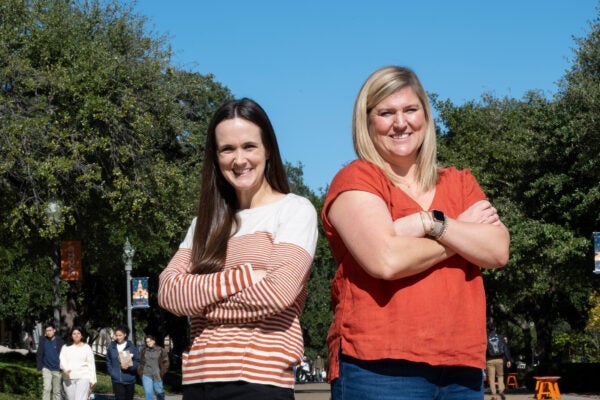
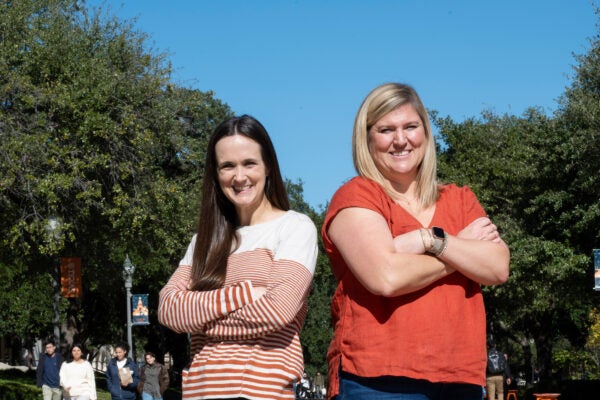
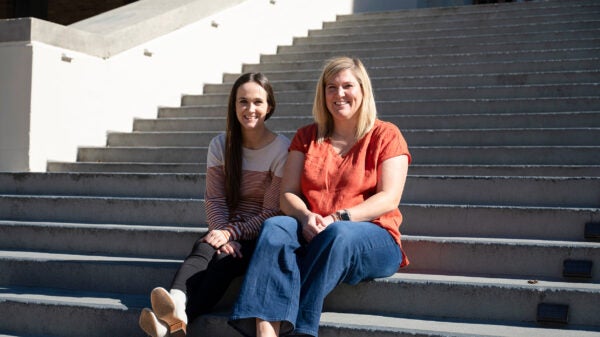
Texas Connect staff spoke with Bridget Jones, senior assistant director for Sport Clubs at Recreational Sports, and Amory Krueger, director of student engagement in the Office of the Dean of Students, about how their work in these areas helps students grow. Some answers have been edited for clarity and length.
My hope here at UT is that students can find their sense of belonging in whatever manner they want.
BRIDGET JONES
Please tell us about your role at the University and your work with students.
I am one of two advisers for the Sport Club program that consists of 40 sponsored student organizations. One of the main components of my role is to serve as liaison between the University and the student organization leadership. Sport Clubs compete under their respective national governing bodies. We assist each organization with compliance to their national governing body as well. Advisers are part of the organization’s support system as we guide them on decision making and transitions.
I find that college students are extremely enjoyable to work with because they are often finding independence for the first time. Higher education provides them with a lot of opportunities to explore and learn about themselves. I feel very fortunate I can work with a large number of student organization leaders directly. My philosophy on developing students as leaders is focusing on their strengths and how their strengths can outweigh their weaknesses. I often say, “Let’s utilize your strengths to become the strongest you.”
How do Sport Clubs help students find community on campus?
Speaking from personal experience, I was someone who participated in sports regularly prior to college. When I began college, I was not involved with any entity other than my on-campus job. I worked in the recreational sports department at my alma mater, and I enjoyed that, but I still felt like a sense of belonging was missing. I joined women’s rugby, and the benefits I received were almost immediate. It changed my career goals, if I’m being honest. Not only was I participating in physical wellness, which improved my academics, but I was being able to do it in a social setting, which also helped. I found a new support system for when maybe I was struggling academically or had a lot going on. I was able to really practice my own personal leadership skills in my undergraduate years in a safe environment, which now translates to my later life.
My hope here at UT is that students can find their sense of belonging in whatever manner they want. So, although my organizations are sports related, that might not be the perfect opportunity for everyone, and I think the University has a large range of opportunities in hopes that students can find their place somewhere outside of the classroom. It’s important to create the sense of belonging for all these students and for them to be able to channel a passion and work with their peers. I do also believe leadership roles in student organizations provide a lot of opportunity to learn about yourself as an individual and gain skills that you need for the workplace once you graduate. I believe that if you are part of a student organization, especially if you’re an officer or a leader, you’re going to make yourself a better employee in any field postgraduation.
What are some ways your programs help students to grow?
I like to use the framework of National Association of Colleges and Employers competencies to evaluate what students learn in our program. Student organization leaders learn how to lead their peers, utilize teamwork to creatively solve problems, enhance their use of technology and the importance of effective communication.
An example I can provide is travel. It is one of the most impressive parts of our program, where student leaders really learn strong skills. Our largest student organization, Texas Taekwondo, can take up to 80 people to their National Championship competition. As a student leader, that can be logistically challenging while following University policies and procedures. However, (the students) have successfully booked airfare and lodging, scheduled transportation with their competition schedules, organized meals and other various details for the last several years. I would hope a future employer would be impressed with the organization and effort it takes to accomplish this while maintaining high academic achievements.
What message are you hoping people know about Sport Clubs?
Our mission statement at Recreational Sports is: “To advance the well-being of Longhorns by providing education through recreation.” Entities on campus may believe that recreational sports is a place in which fun happens, and that is true. We’re very fortunate to be an exciting place with great opportunities for students to engage outside of the classroom. However, whether it be our student employees or our student organization leaders or our participants, a lot of the time, we’re also giving them opportunities to learn. I think putting value on experiences outside of academics is something hopefully most of the UT community can get behind. Academics is the core function of higher education. It is very important and the main purpose why students come here. It’s important for additional experiences to be a part of their time on campus, to make them a more well-rounded person. Educating them on our end is just enhancing the student in the academic setting.
The whole point is that these connections between the University and the community are strong and that students are making that happen.
AMORY KRUEGER
Please tell us about your role at the University.
Our role in our office is really to be a resource to anybody who is looking for volunteers and anybody who wants to volunteer. We try to be a hub and a connector between those two groups of people. My role individually is really to sort of help our programs be successful, help the staff members on our team have all the resources that they need to do all the programs that they do and to make volunteerism part of student life.
What are some of the different volunteer opportunities at UT?
We’re trying to make it as easy as possible for people to volunteer. Anybody can create a profile in GivePulse, which is a platform that we manage and curate for the whole University. We also have some signature programs that provide pathways for students. The volunteer opportunities are designed so that you get to know people that are also interested in service, and then from there, if you want to stay with it, there are opportunities for increasing responsibility of leadership and planning.
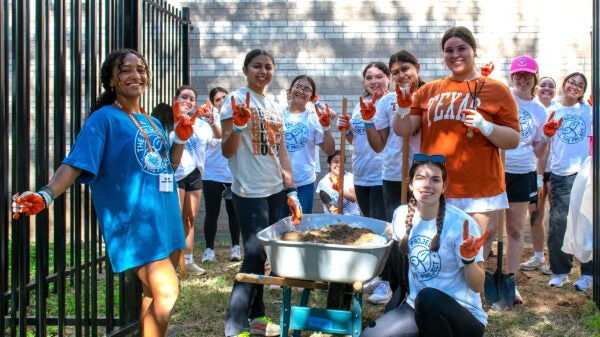
One of those signature events is The Project, which usually happens in the first week or two of November. We had almost 1,000 volunteers that ended up being part of that in 2024. It’s a partnership with the Dove Springs neighborhood and has been for the last couple years. The mission is to bring everyone together to volunteer, but then also to make connections for students and student organizations to keep volunteering in Dove Springs. There’s also Alternative Breaks, which is where students can sign up to go on a spring break or Maymester service trip. For this year over spring break, volunteers are going to Jonesville, Virginia; Memphis, Tennessee; McAllen, Texas; and New Orleans, Louisiana. They’ll do service projects, get to know those communities and hopefully will be able to bring back what they learn to Austin.
How do community partnerships develop?
The Project started in 1999 with a bunch of student organizations who got together. Frankly, Texas A&M University did it first. Then these student organizations said, “We need to do this, too.” They partnered with a neighborhood just east of campus. Every year until 2012, it was a different neighborhood every single year. The thought was that it gave students a chance to make new connections. It was exposure to different parts of Austin, but around that time, the Student Planning Team — and this has been student-run the entire time — decided that they wanted deeper connections with the communities, and so they extended it to two years.
We were in Dove Springs in 2012 and 2013, and credit to that community because they really embraced UT, and they really wanted that extended partnership. I’m really proud of those lasting connections with the University. The whole point is that these connections between the University and the community are strong and that students are making that happen. They are really learning and getting a chance to build their skills and make an impact while they’re here.
Why is volunteering crucial to forming and fostering community, not only when students are at the University, but beyond?
There’s the sort of individual skills that you can gain depending on what you’re doing. Sometimes they’re not obvious skills, or they’re skills that we’re not always thinking about when we’re talking about life at the University. The students at The Project learn how to manage tools. They’re learning how to use drills and put things together. It’s practical life skills. At the same time, they’re learning about all aspects of project management, such as how to match the right number of people to the task, how to create instruction sheets, and how to make a workflow that makes sense over the course of the year. This entails taking into account student schedules and community partner schedules, how to take care of volunteers and how to know what they need, and to meet their needs to make them successful at a work site. Those are all the interpersonal teamwork, communication skills that have been branded as soft skills, but they continue to be the things that employers say that they’re looking for and that help people stand out.