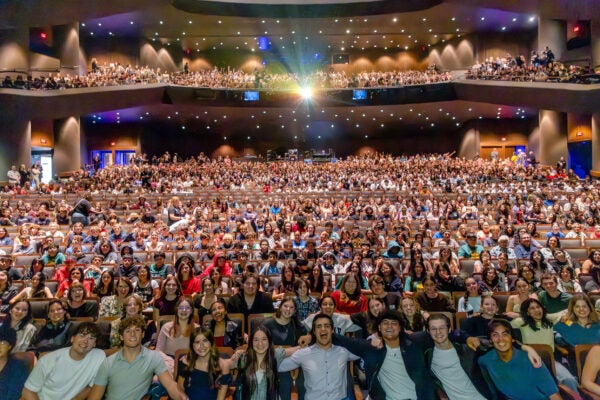
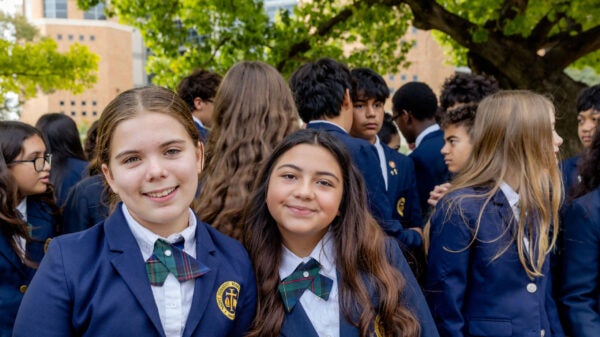
The bustling crowd murmured with excitement as nearly 3,000 K-12 students shuffled into the dimly lit Bass Concert Hall on a Thursday morning in October. For more than two hours, they rode a wave of raw emotion, gasping, laughing and crying alongside the touring cast of Broadway’s Tony Award-winning musical “The Outsiders.” Before the crimson curtain even drew to a close, the theater erupted in a roar of cheers as the young audience jumped to their feet in a standing ovation.
Students from nearly 20 school districts across Central Texas, as well as from private schools and homeschool groups, experienced the joy of live theater, many for the first time, at Texas Performing Arts’ Broadway School Day Performance. This educational program is the latest development in the period of innovative growth TPA has experienced over the past six years under the leadership of Executive and Artistic Director Bob Bursey. In late 2019, Bursey left two decades in the New York arts community behind to move to Austin with his family and take on the role. With him came a drive to diversify the role of TPA as a leading arts organization in one of the country’s fastest-growing cities, uniquely positioned on the campus of Texas’ flagship university.
“Part of the charge when I arrived was to see how (TPA) could have greater prominence and invite more people in, and also to make sure that we kept up with the ways the University and Austin were growing,” Bursey says. “The city has gotten so much bigger. The University continues to grow. We want to make sure that our public arts platform keeps on that same level.”
Throughout his tenure, Bursey has guided TPA’s transformation into the largest campus-based performing arts center in the country through a focus on branching out and stretching the limit on what an organization like it can deliver. From bolstering Austin’s Broadway presence to homing in on the local arts scene and expanding student engagement opportunities, Bursey’s approach has led the organization into a booming era, a trend counter to many arts organizations nationwide. Last season, TPA welcomed over 400,000 audience members to 237 performances, a 40% attendance increase over the 2018-19 season. The organization has also seen major growth in its annual budget, which has more than doubled since fiscal year 2019.
“When we say that we have something for everyone, we really mean it,” Bursey says. “Regardless of what your interests are, what kind of live performance you think you might want to see, we have that on our stages. Having that real breadth and range that reflects the diversity of the campus, of the city and of Texas has been a great strategy for us.”
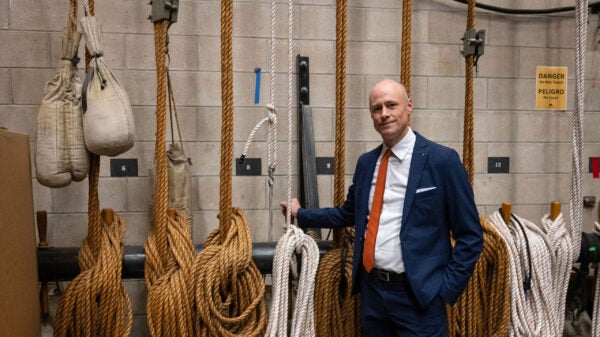
Making this happen requires a future-forward mind and strict regard to the calendar, director of programming Bobby Asher says. Since stepping into the role two years ago, Asher takes the charge in planning TPA’s three performance series — Broadway in Austin, which brings touring productions of Broadway musicals to local audiences; the TPA season, which features theater, dance and music performances; and Texas Welcomes, which features comedy, concerts and family entertainment. Because each series operates on a different schedule, Asher is always thinking ahead.
“We think in seasons,” he says. “So, my brain can be in like three different years at the same time.”
Beyond the calendar, TPA’s programming is driven by a desire to serve its diverse audience in innovative ways, Asher says.
“Our job is to kind of speak for the audience,” he says. “To think about what part of our audience any particular thing is going to be for, what the impact of the project could be, and then to work with all of our colleagues, especially in engagement, to put (on) off-stage activities around those projects with the artists.”
Audience engagement is a high priority for Bursey, particularly when it comes to students. In addition to expanding TPA’s education programs for local K-12 students, he has also made strides in increasing UT student involvement. From bringing artists into the classroom for workshops and masterclasses to expanding accessibility to live performance, Bursey says TPA is always looking for ways to add value to the student experience. In October, TPA’s student ticketing program, known as the Bass Pass, hit an all-time high for student membership after Bursey and his team replaced the previous paid pass with a free, lottery-based system.
“I think it’s because students recognize that coming to a first-class university, the flagship university in our great state, means that they can have an experience in the arts if they’re interested in that, and that it can be affordable, accessible, and it’ll be something that’s relevant to them,” Bursey says.
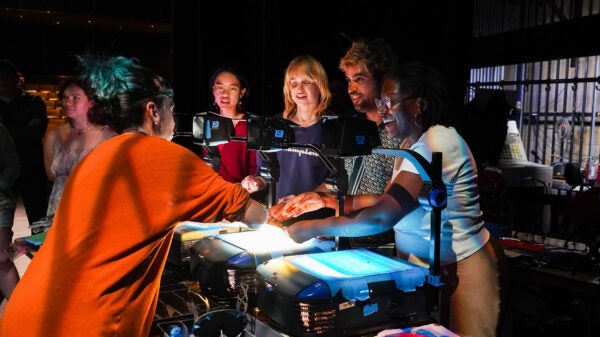
The organization has also seen an expansion in student work opportunities under Bursey’s leadership, now employing 80 to 100 undergraduate students in paid positions throughout all departments. In August 2023, TPA also launched its Emerging Arts Professionals program after Bursey noticed a gap in support for graduating students interested in arts careers.
“There sometimes can be a really hard gap between graduation and a first job, and we wanted to really work in that space to see how we could bridge that for folks,” he says.
The program now annually employs several recent graduates in yearlong, full-time positions to gain professional experience and prepare them for a career in the arts. As a part of the program’s inaugural cohort, Mika O’Dwyer, who graduated from UT’s Theatre and Dance program with a minor in arts management in 2022, says her year working in event management provided a space for her to make mistakes and grow as a young professional.
“I think if I had not been able to get a position like this, that I would probably be close to three to four years behind all of my peers in the world of arts management,” O’Dwyer says. “It definitely has helped me understand how to build relationships within the arts, and then also establish myself as a young leader within our organization.”
Since completing the program last year, O’Dwyer has stepped into a permanent role as production supervisor on TPA’s production team, where she supports day-to-day onstage operations for shows. In the future, she hopes to work as a tour manager for touring artists, but TPA will always be her first home in the arts.
“I think TPA for me will always hold a very special place in my heart because it is the first place that gave me an opportunity and fully believed in me as a young professional,” she says. “We’re getting our name out across the city and across the country and setting the tone for what theater can look like and what performing arts can look like with young people being involved as well.”
When it comes to his role in the growth of the organization over the past six years, Bursey says he is “good at showing people what is possible.” Whether it’s an artist residency to support Austin creators or a spooky Tim Burton-themed partnership with UT’s Lady Bird Johnson Wildflower Center, Bursey is all about thinking outside the box.
“I’m always looking for those wins where we can do something that’s a little bit unexpected or unconventional, and people will really leave changed by it,” he says.
As the arts continue to evolve, Asher says he thinks Bursey has helped to place TPA on the leading edge of interactive, experiential arts innovation.
“Bass Concert Hall is always going to be the place where you come to see Broadway in Austin,” Asher says. “But in all of the other program verticals that we have, I think you’re going to see us be en-gaged in different venues and contexts all around Austin.”
While much of his job revolves around looking at the big picture, Bursey says his favorite part is zooming in and enjoying the display of community that comes together for the pure enjoyment of live theater.
“I love to stand in the lobby and see the audience coming in, because everybody is there because they have chosen to be,” he says. “We work in the business of arts, entertainment. Those are optional. They’re discretionary things; nobody’s being forced to do it. So, to see that, night in and night out, there are thousands of people who want to come onto our campus, to be in our theater, to have an experience together — that is absolutely my favorite part.”